

Intestinal permeability and "leaky gut" testing
An honest account of what leaky gut testing can and cannot tell you, and what we check first when gut symptoms are real but the standard tests came back normal.

 Your results are reviewed one-to-one by our dietitian team,
Jaceme Chuah
and
Jess Yii
- ★ 4.8 on Google From 26 reviews
- Lactulose–mannitol Our permeability method, not zonulin
- Ask first Talk it through before you spend
- Tue–Sat 10am–5pm, by appointment
What leaky gut and intestinal permeability actually are
The gut lining is a selective barrier. It absorbs nutrients while keeping bacteria and partially digested food out of the bloodstream, and the junctions between the cells open and close to control this. Intestinal permeability describes how open that barrier is.
This is a real, well-described phenomenon. Increased permeability is documented in coeliac disease, inflammatory bowel disease, serious infection and heavy alcohol use. The science is genuine, and it is an active research field.
"Leaky gut syndrome" is the name used online and in some functional medicine clinics for a cluster of symptoms, such as bloating, fatigue and poor concentration. It is not a recognised diagnosis. Increased intestinal permeability is a measurable finding. Whether it causes those symptoms in otherwise healthy people has not been shown.
Where the evidence stops
What has not been established is the step commercial testing depends on: that measuring permeability in a person with everyday digestive symptoms produces a number you can act on, or that changing it improves how they feel.
The commonly sold marker is zonulin . Several widely used zonulin assays have been shown not to measure zonulin reliably, and results vary between laboratories. Lactulose–mannitol urine testing is better validated as a research tool, but it is affected by kidney function, gut transit time and what you ate beforehand. There is no agreed threshold that separates "normal" from "needs treatment" in an otherwise healthy person.
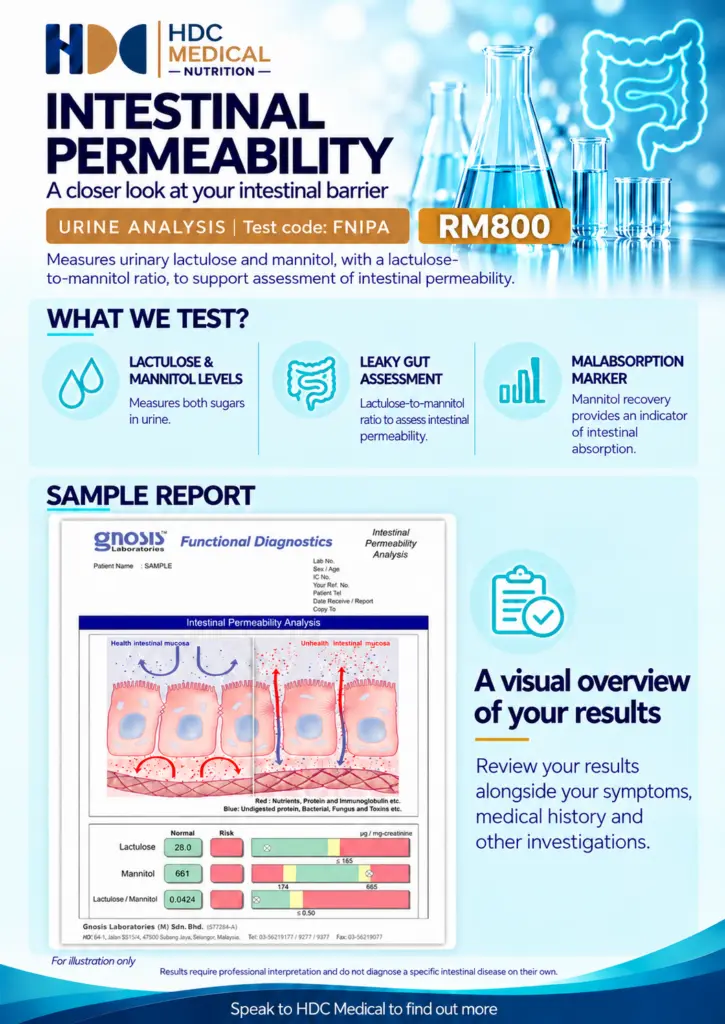
We do offer intestinal permeability testing (RM800), using the lactulose–mannitol method rather than zonulin. Given the limits above, we suggest it only after the more common causes below have been checked, and we explain what it can and cannot show before you book. A result on its own does not diagnose a condition. Prices may change; please confirm when you book.
This sits alongside our wider position in Functional lab testing: what is evidence-based and what is not .
How do you test for leaky gut?
The lactulose–mannitol test is the better-validated intestinal permeability test. You drink a solution of two sugars. Mannitol is small and normally passes through the intestinal lining. Lactulose is larger and normally poorly absorbed. Both are excreted into the urine, and the ratio of lactulose to mannitol in a timed urine sample gives an estimate of how permeable the gut barrier is.
That number carries the limits described above: kidney function, gut transit and recent meals all affect it, and there is no agreed cut-off for gut permeability in an otherwise healthy person. We explain the preparation when you book.
Zonulin, a biomarker often sold in at-home leaky gut tests, is the least reliable option. A gut microbiome stool test describes which bacteria are present. It does not measure intestinal permeability, and it cannot diagnose leaky gut.
The symptoms of leaky gut are still real
Bloating, irregular bowels, discomfort after eating and fatigue are common gastrointestinal symptoms, and genuinely disruptive. Saying that a particular test is unreliable is not the same as saying nothing is wrong. It usually means the answer is somewhere more ordinary, and more manageable.
What we look at instead
- Coeliac screening: tissue transglutaminase antibodies with total IgA. Coeliac disease is underdiagnosed and genuinely causes increased permeability. It must be tested while you are still eating gluten.
- Inflammation and blood count: hs-CRP, full blood count and ferritin. Iron deficiency with gut symptoms needs explaining, not supplementing.
- Thyroid and metabolic markers: both alter gut motility and are easily missed.
- Faecal calprotectin: separates inflammatory bowel disease from irritable bowel syndrome, and is a genuinely useful test.
- A proper dietary assessment: most bloating traces back to fermentable carbohydrates, lactose, eating pattern or fibre load. A structured elimination and reintroduction, supervised so the diet does not narrow permanently, identifies triggers more reliably than any panel.
- True food allergy, where the pattern fits: see our allergy testing and the difference between allergy and intolerance .
Supporting gut health without a leaky gut label
There is no validated test-and-treat route for leaky gut in an otherwise healthy person. What helps is more ordinary:
- Treat the underlying cause. The known causes of raised permeability include coeliac disease, inflammatory bowel disease, serious infection and heavy alcohol use. Managing that cause is what matters. In coeliac disease, that means a strict gluten-free diet guided by your doctor.
- Find your dietary triggers with a supervised elimination and reintroduction, rather than an open-ended list of foods to avoid.
- Irritable bowel syndrome frequently responds to a supervised low-FODMAP approach.
- Keep alcohol moderate. Heavy alcohol use is one documented cause of increased permeability.
- Be wary of a protocol attached to a result. If the same "gut healing" supplement list follows every test, the test is not driving the recommendation.
When to see a doctor rather than book a screening
Some symptoms need medical assessment first, not a nutrition plan. Please see a doctor promptly if you have:
- Blood in the stool
- Unintentional weight loss
- Difficulty swallowing
- Persistent vomiting
- A change in bowel habit lasting more than six weeks, if you are over 45
- A family history of bowel cancer or inflammatory bowel disease
From booking to a plan you can use
No hospital queues. Our clinic sees people by appointment.
-
Book on WhatsApp
Send your age, main concern and a preferred date. We are open Tuesday to Saturday, 10am–5pm.
-
Come in for your blood draw
At Oval Damansara. If your package includes fasting glucose or a lipid profile, fast for 8–12 hours. Plain water is fine.
-
Get your results
Routine results are usually ready in 24–72 hours. Specialised panels can take longer; we confirm timing when you book.
-
Go through them together
A one-to-one review of every result, with personalised nutrition guidance you can start on straight away.
Who goes through your results
Book a screening at our Kuala Lumpur clinic and your results come with a one-to-one review by this team, in plain language, with a plan to follow.

Jaceme Chuah
Co-Founder · Registered Dietitian
Over 8 years of clinical nutrition care and 2,000+ consultations. Jaceme built HDC’s dietitian-led review model.
- BSc (Hons) Dietetics with Nutrition, IMU
- IDF International Diabetes Educator
- HRD Corp Accredited Trainer
- Diabetes, kidney and metabolic nutrition
English · Mandarin · Malay · Hokkien
Full profile →
Jess Yii Poh Kee
Clinical Dietitian · Functional Nutritionist
Australia-trained, with a friendly, practical style: personalised meal planning and habit change that fits real Malaysian lifestyles.
- BHSc Nutritional & Dietetic Medicine, Endeavour College, Australia
- Professional Qualification in Nutritional & Functional Medicine
- Clinical, metabolic and preventive nutrition
English · Chinese · Malay
Full profile →Frequently asked questions
Do you offer a leaky gut test?
Yes. We offer intestinal permeability testing using the lactulose–mannitol method rather than zonulin. We suggest it only after the more common causes have been checked, and we explain what it can and cannot show before you book.
Is zonulin testing reliable?
Several widely used zonulin assays have been shown not to measure zonulin reliably, and results vary between laboratories. Our permeability test uses the lactulose–mannitol method instead.
Can I test for leaky gut at home?
Home kits are usually zonulin or stool microbiome tests. Zonulin assays have the reliability problems described above, and a gut microbiome test does not measure intestinal permeability. Neither can diagnose leaky gut.
What about gut symptoms in children?
A child’s gut symptoms should be assessed by a doctor first. Avoid restrictive "gut healing" diets: cutting foods without good reason can affect growth and nutrition. Where a food trial is needed, it should be supervised.
Where to find us
HDC Medical, Unit 3A-08 Oval Damansara, 685 Jalan Damansara, 60000 Kuala Lumpur. Appointment only. See our screening packages for what is included.
This article is for general education and does not replace individual medical advice. Persistent or alarming digestive symptoms should be assessed by a doctor.
Talk it through first
If you have been offered a leaky gut test elsewhere, or you have a result you are unsure about, message us on WhatsApp before you spend anything. We will tell you honestly whether testing will change the plan, and often it will not.