
Hair Mineral Analysis (HTMA): What a Hair Tissue Mineral Analysis Can and Cannot Show
Hair mineral analysis, also called hair tissue mineral analysis or HTMA, measures minerals and metals in a small sample of hair. It is widely marketed for checking mineral status and toxic metals, but hair is easily affected by shampoo, water, dye and treatments. This guide explains what an HTMA test measures, how the hair sample is collected, what it can and cannot show, and when a blood or urine test is the better choice.
Part of our blood test results guide: what each marker means and when it is worth testing. New to testing? Start with our guide to getting a blood test in KL.
Key takeaways
- The test measures major minerals, trace elements and potentially toxic metals in a hair sample.
- Hair results are easily affected by external contamination , such as shampoo, water, dye and hair treatments.
- It does not diagnose a nutrient deficiency or metal poisoning. Blood or urine are the validated samples for that.
- It may be useful as a broad exposure overview , read with your history and other tests.
- At HDC Medical it costs RM1,820 , including an InBody scan and a one-to-one review of your report.
What is HTMA (hair tissue mineral analysis)?
As hair grows, minerals and trace elements from the blood are deposited in the hair shaft. A hair tissue mineral analysis measures the mineral content of a small hair sample, usually the length closest to the scalp, which reflects roughly the past few months of hair growth.
Laboratories typically use inductively coupled plasma mass spectrometry (ICP-MS), which can detect very small amounts of each element, reported in micrograms per gram of hair. An HTMA test is non-invasive, which is one reason it is popular, but the accuracy of the mineral levels it reports depends heavily on sample collection and contamination.
What the HTMA test measures
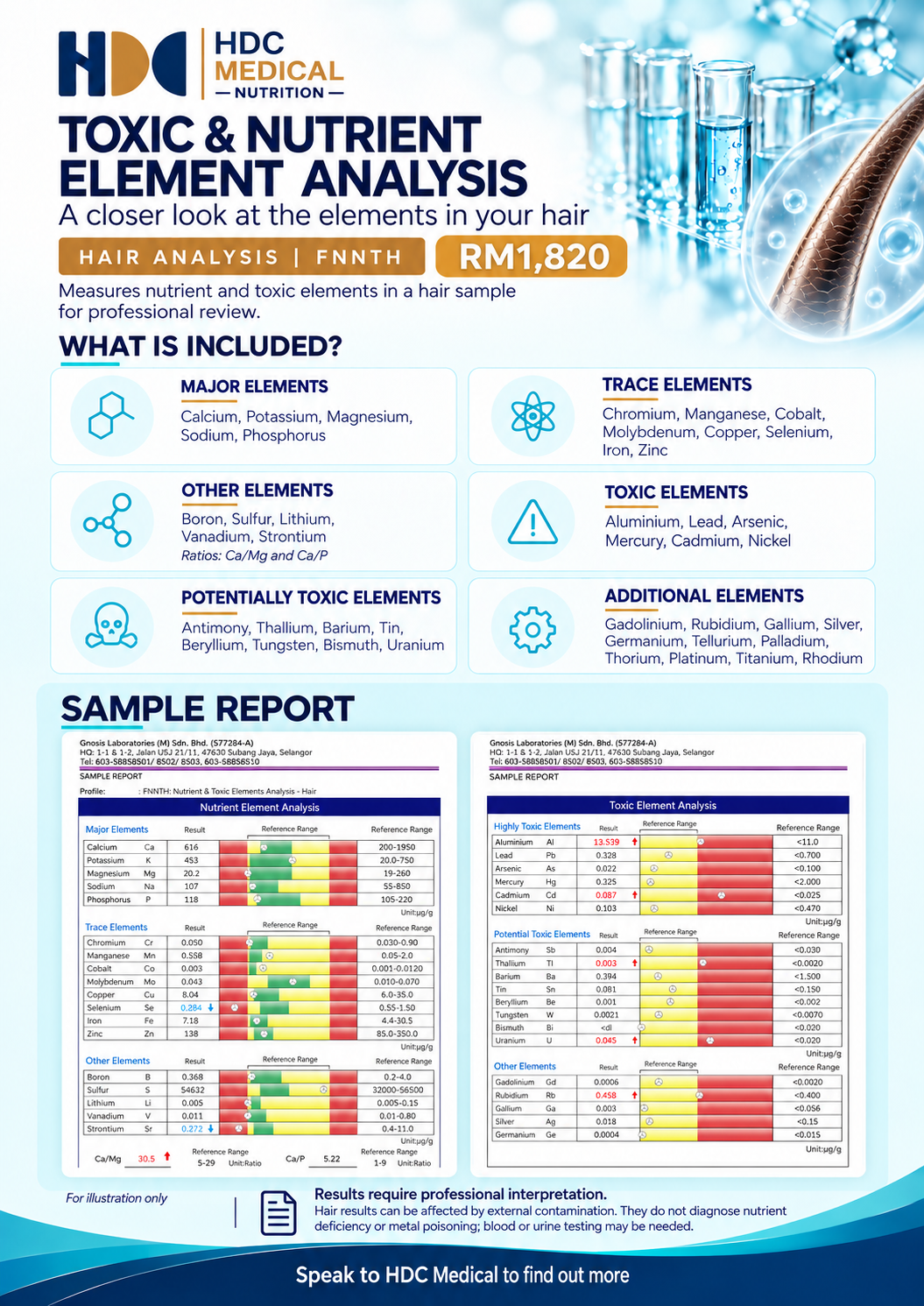
The test uses a small hair sample and is analysed by Gnosis Laboratories. It reports:
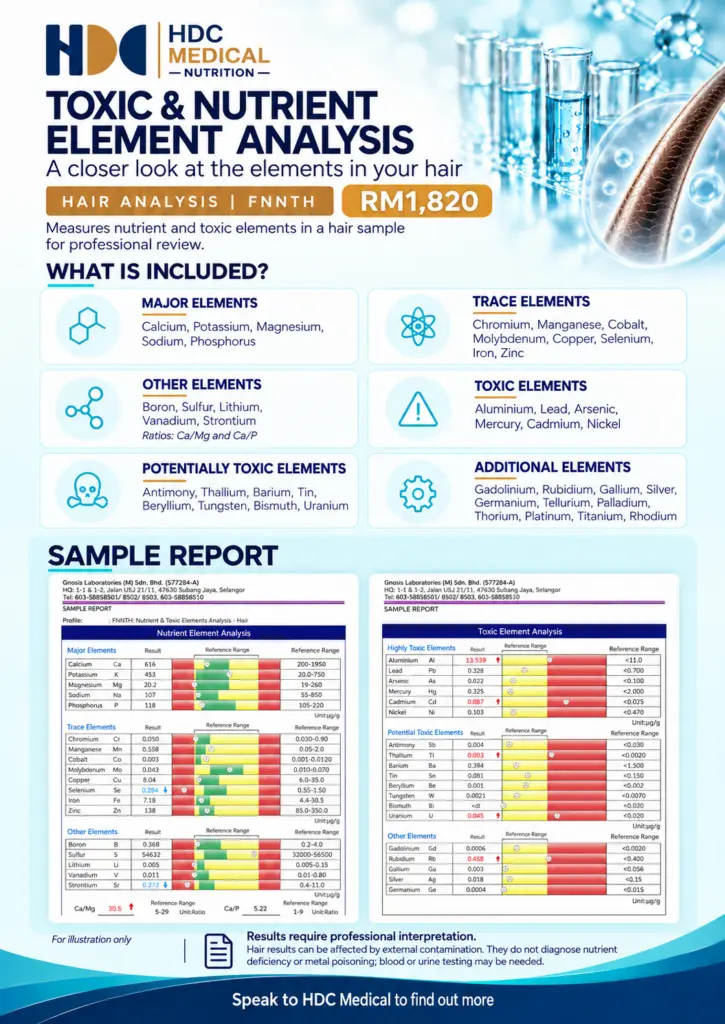
| Group | Elements |
|---|---|
| Major elements | Calcium, magnesium, sodium, potassium, phosphorus, with Ca/Mg and Ca/P ratios |
| Trace elements | Chromium, manganese, cobalt, molybdenum, copper, selenium, iron, zinc |
| Toxic elements | Aluminium, arsenic, cadmium, lead, mercury, nickel |
| Other and potentially toxic elements | Including antimony, barium, beryllium, bismuth, thallium, tin, tungsten and uranium |
How the hair sample is collected
- A small sample of hair is cut close to the scalp, usually from the back of the head. We give you the laboratory’s instructions.
- Tell us about recent hair dye, bleaching, perming or straightening, and regular swimming, as these change mineral readings.
- Laboratories wash the hair before analysis, but washing cannot remove all external contamination.
The limits of hair testing
- Mineral imbalances in hair do not always match the body: hair mineral levels and blood mineral levels often disagree, so an HTMA result cannot confirm a mineral deficiency on its own.
- Contamination: shampoo, hard water, hair dye, bleaching and treatments all change the reading.
- Variable results: studies that sent identical hair samples to different laboratories received different results and different advice.
- No diagnosis: a hair result cannot confirm a mineral deficiency or metal poisoning.
- Not a basis for chelation or "detox" treatment. Be cautious of anyone offering these on the strength of a hair test.
HTMA, mineral ratios and claims about the thyroid and adrenals
Some practitioners use mineral ratios in an HTMA report, such as calcium to magnesium or sodium to potassium, to describe thyroid function, adrenal function, metabolic type or a "stage of stress". There is no good evidence that hair mineral ratios measure thyroid or adrenal function.
If you want to check your thyroid, a thyroid blood test is the reliable option. See our thyroid function test guide .
When blood or urine is the better test
If you are worried about a specific metal, such as lead or mercury, or a specific nutrient, such as iron or zinc, blood or urine testing is more reliable. See our heavy metal test guide and Nutrient Deficiency Test .
Who might consider a hair test
- You want a broad overview of possible exposures, to be followed up with blood or urine testing if anything stands out
- You are working with a practitioner who uses hair results as one part of a wider assessment
Please tell us about recent hair treatments, swimming and supplements before you test, so we can read the result fairly.
Price and booking at HDC Medical
The Toxic & Nutrient Element Analysis costs RM1,820 at HDC Medical in Oval Damansara, Kuala Lumpur. The price includes an InBody body-composition scan and a one-to-one review of your report with our dietitian team.
Message us first. If blood or urine would answer your question better, we will tell you.
Related reading: heavy metal test , nutrient deficiency test , functional lab testing , blood test packages .
References
- Seidel S, Kreutzer R, Smith D, McNeel S, Gilliss D. Assessment of commercial laboratories performing hair mineral analysis. JAMA. 2001;285(1):67–72.
This article is for general education and does not replace personalised medical advice. Reference ranges vary between laboratories — always interpret your results with a qualified professional. HDC Medical is a dietitian-led health screening centre in Oval Damansara, Kuala Lumpur.
Frequently asked questions
Is hair mineral analysis accurate?
Hair results are easily affected by shampoo, water, dye and treatments, and different laboratories can report different results for the same sample. It can give a broad overview, but it cannot diagnose a deficiency or poisoning.
What is the HTMA test?
HTMA (hair tissue mineral analysis) measures minerals, trace elements and toxic metals in a small hair sample, usually using mass spectrometry.
Does HTMA replace blood tests?
No. Blood and urine tests are the validated samples for checking mineral deficiencies and heavy metal exposure. HTMA can give a broad overview to be followed up with blood or urine testing if anything stands out.
Is hair analysis still used?
Yes. Hair analysis is used in research and forensic settings, for example to document past exposure to some metals, and by some practitioners as a screening tool. It is not used to diagnose deficiencies or poisoning.
Can a hair test detect heavy metal poisoning?
Not reliably on its own. Blood and urine are the validated samples for checking metals such as lead and mercury.
How much is hair mineral analysis in Malaysia?
At HDC Medical the Toxic & Nutrient Element Analysis costs RM1,820, including an InBody scan and a one-to-one review of your report.
Should I do a detox based on my hair test?
No. Chelation and "detox" treatments should not be started on the basis of a hair test. If a metal is a concern, confirm it with blood or urine testing and see a doctor.
Choose the sample that answers your question.
Book a dietitian-led screening at HDC Medical in Kuala Lumpur. Your results explained in plain language, with a plan to follow.