
Xenoestrogen Test: Measuring Your Exposure to Xenoestrogens Such as Phthalates, Parabens and BPA
Phthalates, parabens and bisphenol A (BPA) are chemicals used in plastics, food packaging, cosmetics and personal care products. Some can mimic estrogen in the body, which is why they are called xenoestrogens or endocrine disruptors. The Xenoestrogen Metabolism test measures these chemicals and their breakdown products in urine. This guide explains what it shows, its limits and practical ways to reduce your exposure.
Part of our blood test results guide: what each marker means and when it is worth testing. New to testing? Start with our guide to getting a blood test in KL.
Key takeaways
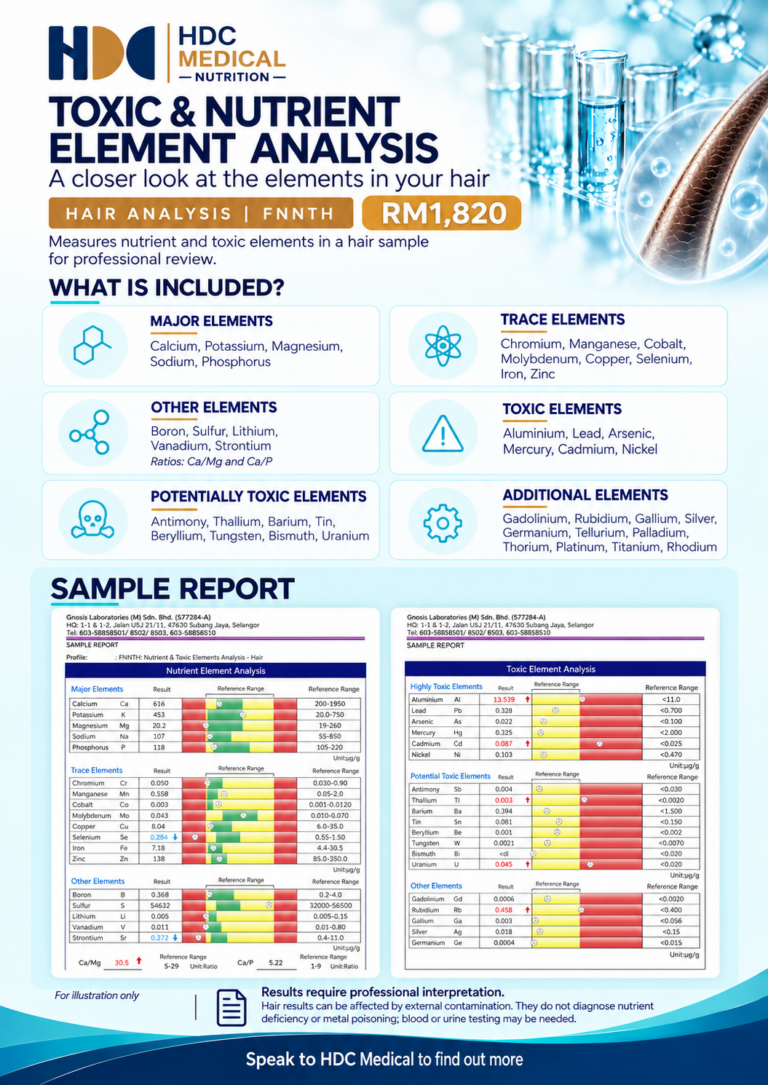
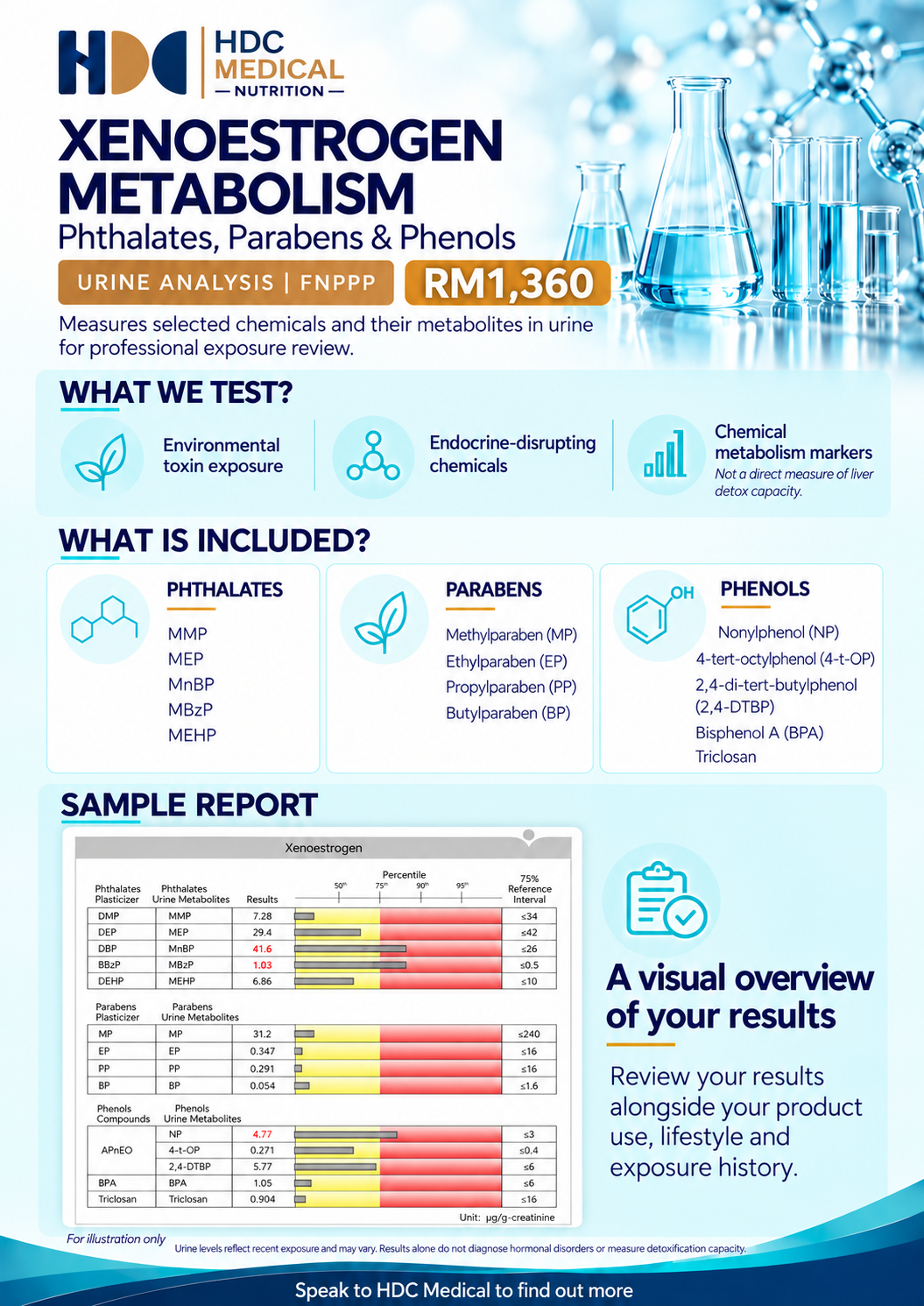
- The test measures 5 phthalates, 4 parabens and 5 phenols, including BPA and triclosan , in a urine sample.
- Most of these chemicals leave the body within hours to days , so the result reflects recent exposure , not a long-term build-up.
- Almost everyone has detectable levels ; there are no agreed cut-offs that link a level to a disease.
- Its main use is to show your exposure and track it after you change products or habits.
- At HDC Medical it costs RM1,360 , including an InBody scan and a one-to-one review of your report.
What are xenoestrogens?
Xenoestrogens are man-made chemicals that can act like estrogen in the body. Many of them can bind to estrogen receptors, the same receptors that your own (endogenous) estrogen uses, and switch on weak estrogenic activity. Others interfere with how sex hormones are made, carried or broken down. Together they belong to a wider group called endocrine disruptors, or endocrine-disrupting chemicals.
Their estrogenic effect is usually much weaker than the body’s own estradiol or a synthetic estrogen medicine, but exposure is frequent and comes from many sources at once. That is why environmental health researchers study the combined effect of everyday exposure to xenoestrogens and other environmental contaminants, rather than any single chemical.
Exposure is mostly through food and drink stored or heated in plastic, fragranced products, cosmetics, canned food linings and thermal paper receipts.
Sources of xenoestrogens
Common types of xenoestrogens and where they come from:
| Type of xenoestrogen | Common sources |
|---|---|
| Phthalates (plasticisers) | Soft plastics, food packaging, vinyl flooring, fragrance, nail polish, some medicines |
| Parabens (preservatives) | Lotions, shampoos, cosmetics, some processed foods |
| Bisphenol A (BPA) and related bisphenols | Polycarbonate bottles, the lining of food and drink cans, thermal paper receipts |
| Alkylphenols such as nonylphenol | Detergents, industrial cleaners, some plastics |
| Triclosan | Some antibacterial soaps, toothpastes and household products |
| Pesticides and herbicides, flame retardants, PCBs | Food residues, house dust, older electrical equipment; some are persistent in the environment |
The HDC test measures phthalates, parabens and phenols (including BPA and triclosan). It does not measure pesticides, flame retardants or PCBs.
Xenoestrogens vs phytoestrogens
Phytoestrogens are natural plant compounds with weak estrogenic activity. The best known are the isoflavones in soy foods such as tofu, tempeh and soy milk, and the lignans in flaxseed. Xenoestrogens are synthetic chemicals; phytoestrogens come from food.
Both can bind to estrogen receptors, but they are not the same. For most people, soy and other phytoestrogen-rich foods are part of a healthy diet, and large human studies have not shown that eating soy foods raises the risk of breast cancer. This test does not measure phytoestrogens.
How xenoestrogens act in the body
Xenoestrogens are sometimes called environmental estrogens or "hidden hormone disruptors". Their biological activity depends on the chemical, the dose and the timing of exposure. Several mechanisms have been described in laboratory research:
- Binding estrogen receptors: some xenoestrogens bind the classic estrogen receptors (ER-alpha and ER-beta) and the G protein-coupled estrogen receptor (GPER), mimicking endogenous estrogen.
- Blocking or altering hormone signals: others partly block estrogen receptor signalling, or change how much estrogen and testosterone the body makes.
- Changing hormone breakdown: some affect the enzymes that metabolise sex hormones in the liver.
- Building up in fat tissue: a few, such as some brominated flame retardants and older pesticides, are persistent environmental pollutants that build up in body fat. The chemicals in this test are mostly short-lived and leave the body quickly.
Laboratory findings do not automatically translate into adverse health effects in people. Dose, the mixture of chemicals and the route of exposure (food, skin or air) all matter, which is why environmental exposure to xenoestrogens is still an active research area in environmental health.
Effects of xenoestrogens: what the research shows
Much of what we know about the effects of xenoestrogens comes from laboratory studies. In human breast cancer cell lines, such as MCF-7 cells, some xenoestrogens such as BPA can activate estrogen receptor signalling and encourage cell growth, and similar studies have looked at prostate cancer cells. Animal studies have also linked high exposure to endocrine disruption, changes in breast development, the early onset of puberty and reproductive health.
In people, the picture is less clear. Observational studies have linked higher exposure to endocrine-disrupting chemicals with changes in sex hormones, sperm quality and metabolic health, but cause and effect is hard to prove because exposure is so widespread and varies from day to day. Whether environmental estrogens increase the risk of breast cancer in women is still being studied, and no single chemical level has been shown to predict it.
A reasonable, evidence-based approach is to reduce avoidable exposure, especially during pregnancy and childhood, without alarm about any one product.
What the xenoestrogen test measures
The test uses a urine sample and is analysed by Gnosis Laboratories.
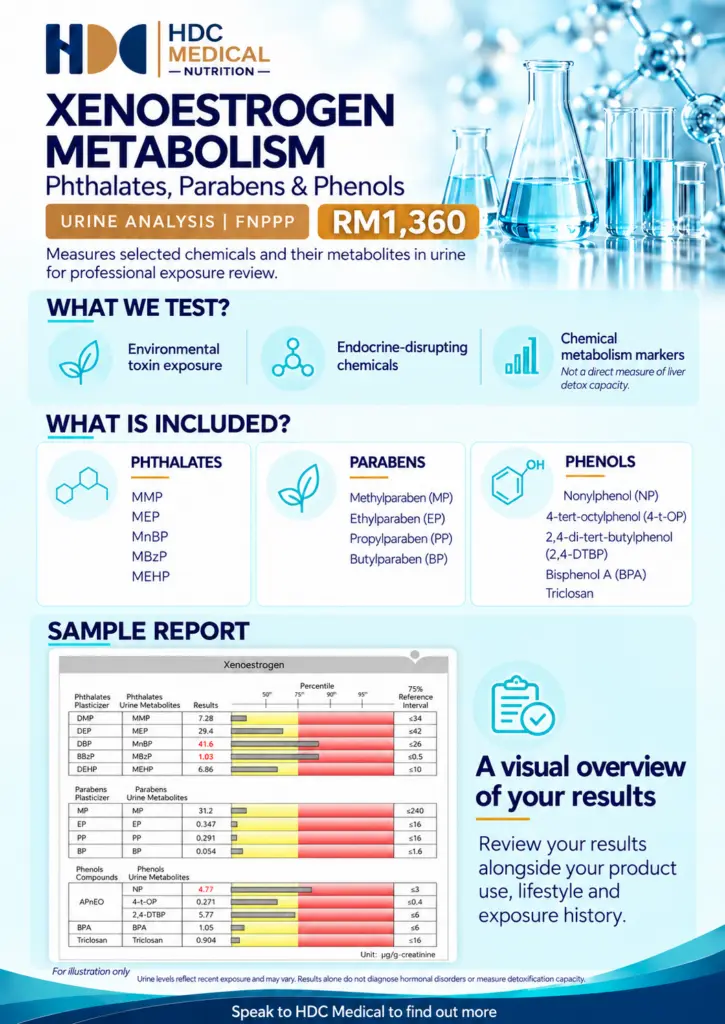
| Group | Markers | Common sources |
|---|---|---|
| Phthalates (as urine metabolites) | MMP, MEP, MnBP, MBzP, MEHP | Soft plastics, food packaging, fragrance, nail polish, vinyl |
| Parabens | Methyl-, ethyl-, propyl- and butylparaben | Preservatives in cosmetics, lotions and some foods |
| Phenols | BPA, nonylphenol, 4-tert-octylphenol, 2,4-DTBP, triclosan | Can linings, polycarbonate plastic, thermal receipts, some soaps and toothpaste |
What this test cannot tell you
- It is a snapshot of the last day or two. Levels can change a lot from one day to the next, depending on what you ate and used.
- There are no clinical cut-offs. A higher level shows more exposure than average, not that it has harmed you.
- It does not diagnose hormone disorders or infertility.
- It does not measure "detox capacity". It measures what is being excreted.
Who might consider this test
- You want to understand your exposure to everyday chemicals and what drives it
- You are trying to conceive and want to reduce avoidable exposures (alongside, not instead of, standard fertility tests)
- You want to measure the effect of switching products or food storage
If you have specific hormone symptoms, a blood hormone profile or our women’s health screening is the better first test.
Practical ways to reduce your exposure
- Do not heat food in plastic. Microwave in glass or ceramic, and let hot food cool before putting it in plastic containers
- Choose fresh or frozen food over canned where you can
- Use glass or stainless steel bottles and lunch boxes
- Pick fragrance-free and paraben-free personal care products where practical
- Decline paper receipts , or wash your hands after handling them
- Retest after a few months of changes to see the difference
Price and booking at HDC Medical
The Xenoestrogen Metabolism test costs RM1,360 at HDC Medical in Oval Damansara, Kuala Lumpur. The price includes an InBody body-composition scan and a one-to-one review of your report with our dietitian team, with a practical list of changes for your home and diet.
Message us before you book and we will check that the test suits your question.
Related reading: estrogen metabolism test , women’s health screening , heavy metal test , blood test packages .
References
- Centers for Disease Control and Prevention. National Biomonitoring Program: Phthalates factsheet .
- Centers for Disease Control and Prevention. National Biomonitoring Program: Bisphenol A factsheet .
- Gore AC, et al. EDC-2: The Endocrine Society’s second scientific statement on endocrine-disrupting chemicals. Endocr Rev. 2015;36(6):E1–E150.
This article is for general education and does not replace personalised medical advice. Reference ranges vary between laboratories — always interpret your results with a qualified professional. HDC Medical is a dietitian-led health screening centre in Oval Damansara, Kuala Lumpur.
Frequently asked questions
What does a xenoestrogen test measure?
It measures phthalate metabolites, parabens and phenols such as BPA and triclosan in your urine. These chemicals come from plastics, packaging and personal care products.
What are examples of xenoestrogens?
Common xenoestrogens include phthalates in soft plastics and fragrance, parabens in cosmetics, bisphenol A (BPA) in can linings and thermal receipts, alkylphenols in detergents, triclosan, and some pesticides and flame retardants.
What is the difference between xenoestrogens and phytoestrogens?
Xenoestrogens are synthetic chemicals that can act like estrogen. Phytoestrogens are natural compounds in plant foods such as soy and flaxseed. Both can bind to estrogen receptors, but soy foods are considered safe and healthy for most people.
Are xenoestrogens a breast cancer risk factor?
Laboratory studies show that some xenoestrogens can stimulate breast cancer cells, but human studies have not established that everyday exposure causes breast cancer. Research is ongoing, so reducing avoidable exposure is a sensible precaution.
Does a high result mean the chemicals are harming me?
Not necessarily. There are no agreed cut-offs that link a urine level to a disease. A higher result shows more recent exposure than average, which you can usually reduce.
How long do phthalates and BPA stay in the body?
Most leave the body in urine within hours to a day or two, so the test reflects recent exposure. Ongoing daily exposure keeps levels detectable.
How much is a xenoestrogen test in Malaysia?
At HDC Medical the Xenoestrogen Metabolism test costs RM1,360, including an InBody scan and a one-to-one review of your report.
How can I lower my BPA and phthalate levels?
Avoid heating food in plastic, choose fresh food over canned, use glass or stainless steel containers, pick fragrance-free products and avoid handling thermal receipts.
See your everyday chemical exposure, then reduce it.
Book a dietitian-led screening at HDC Medical in Kuala Lumpur. Your results explained in plain language, with a plan to follow.