
Estrogen Metabolism Test: Estrogen Metabolites, the 2/16 Ratio and What They Can Tell You
Your body breaks estrogen down through several pathways, and some researchers have proposed that the balance between them matters for health. The Estrogen-META Analysis measures these breakdown products, called estrogen metabolites, in urine. This guide explains what the test measures, what the research actually shows, and what it cannot tell you, so you can decide whether it is worth doing.
Part of our blood test results guide: what each marker means and when it is worth testing. New to testing? Start with our guide to getting a blood test in KL.
Key takeaways
- The test measures the estrogen metabolites 2-OHE1, 4-OHE1, 16α-OHE1 and 2-MeOE1 and their ratios in a urine sample.
- The 2-OHE1 to 16α-OHE1 ratio has been studied as a breast cancer risk marker, but results have been inconsistent .
- It is not a cancer screening test and does not replace a mammogram or breast examination.
- It does not directly measure liver detox or your overall hormone balance.
- At HDC Medical it costs RM960 , including an InBody scan and a one-to-one review of your report.
How the body breaks down estrogen
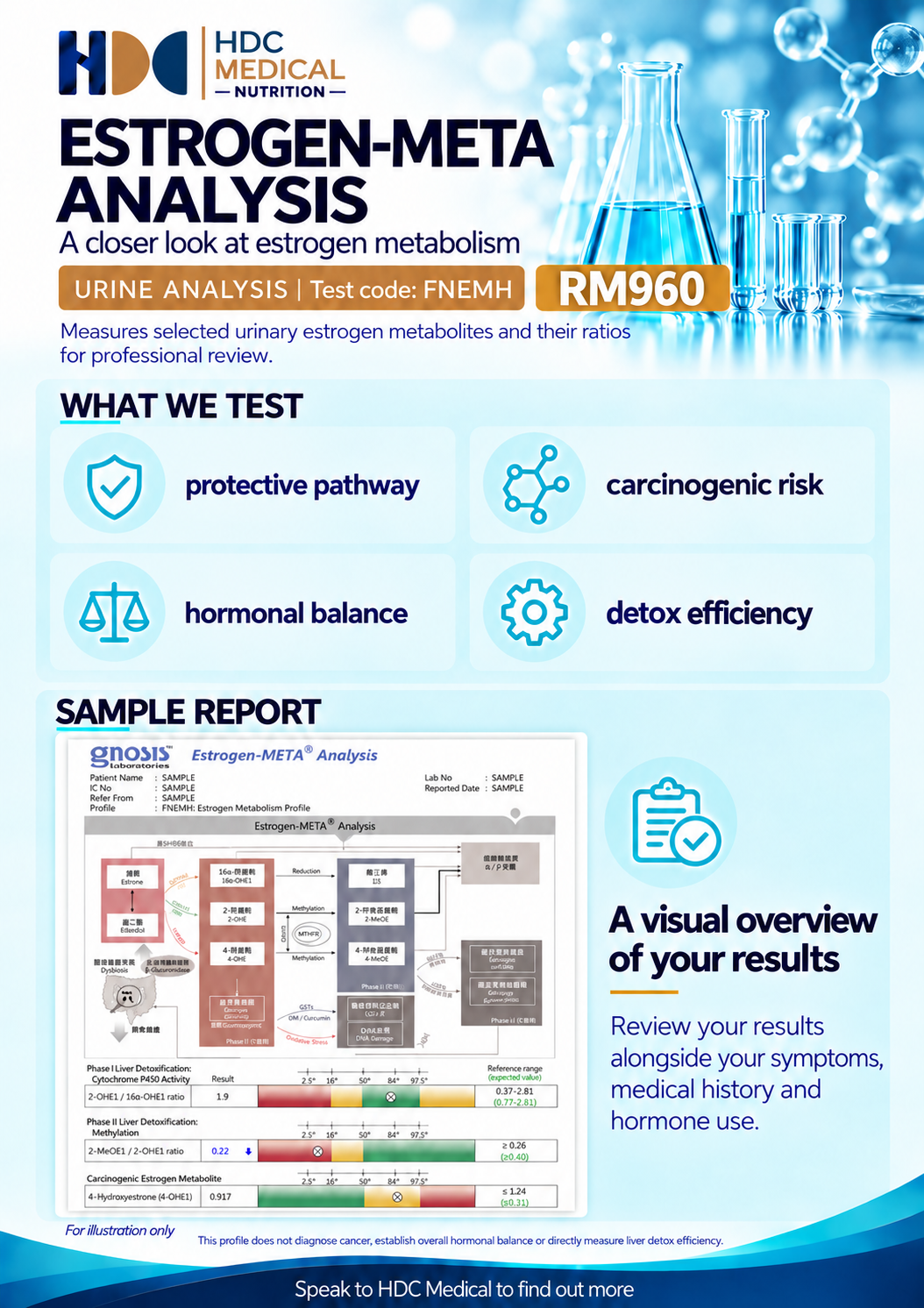
Estrogens are processed mainly in the liver. In the first step, estrone is converted to one of three hydroxylated forms: 2-hydroxyestrone (2-OHE1), 4-hydroxyestrone (4-OHE1) or 16α-hydroxyestrone (16α-OHE1). In a second step, some of these are methylated, for example 2-OHE1 to 2-methoxyestrone (2-MeOE1), before they leave the body.
Laboratory studies suggest the forms behave differently: 2-OHE1 is weakly estrogenic, while 16α-OHE1 and 4-OHE1 are more active and, in cell studies, can damage DNA. That is why the ratios became a research interest.
The three forms of estrogen: estrone, estradiol and estriol
Your body makes three main forms of estrogen. Estradiol (E2) is the strongest and the main estrogen in women before menopause. Estrone (E1) is weaker and becomes the main estrogen after menopause, when it is made mostly in fat tissue. Estriol (E3) is the weakest and is made in large amounts during pregnancy. Men make smaller amounts of all three.
A blood test measures how much hormone is present, such as your estradiol level. An estrogen metabolism test looks at a different question: how your body breaks estrogen down into metabolites before it leaves in the urine.
Urine, blood, saliva or DUTCH test? How estrogen metabolism is measured
- Urine (this test): measures estrogen metabolites in a urine sample.
- Blood: measures hormone levels such as estradiol, progesterone and testosterone, but not most metabolites. See our postmenopause hormone test and male hormone test .
- DUTCH test (dried urine): a commercial dried urine test that reports sex hormone metabolites and a daily cortisol pattern. HDC does not offer it.
- Saliva: used by some clinics for hormone levels, but results are less reliable than blood.
None of these tests on its own diagnoses a "hormone imbalance". Results are read alongside symptoms, hormone levels and medical history.
What the Estrogen-META Analysis measures
The test uses a urine sample and is analysed by Gnosis Laboratories. It reports:
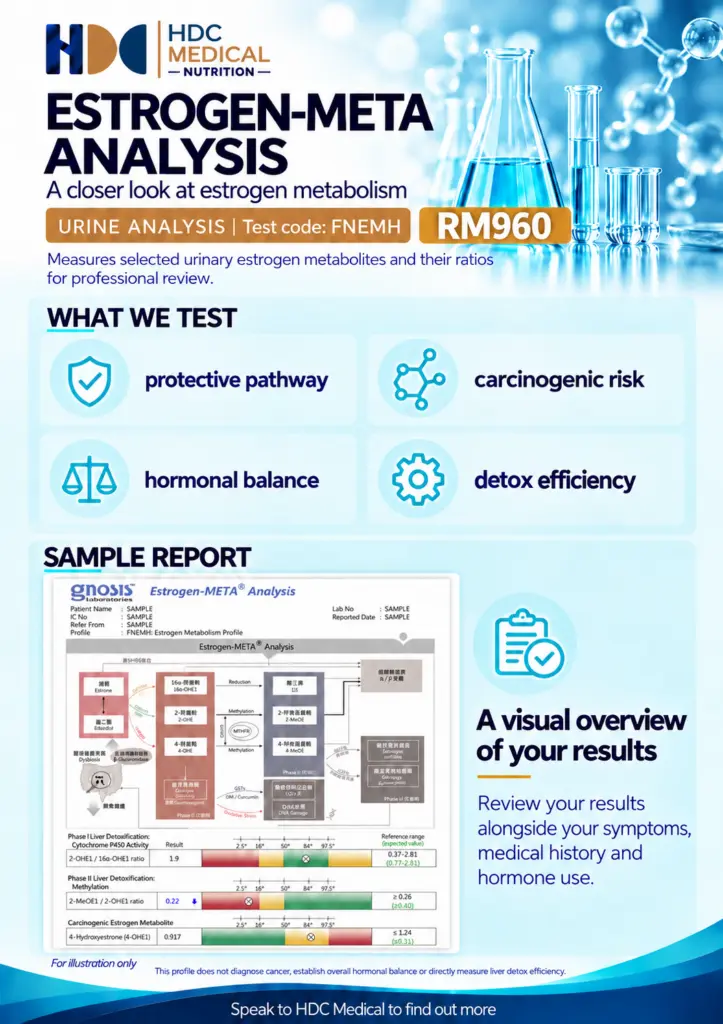
- 2-OHE1, 4-OHE1 and 16α-OHE1 , the first-step metabolites
- The 2-OHE1 to 16α-OHE1 ratio
- 2-MeOE1 and the 2-MeOE1 to 2-OHE1 ratio , a marker of the methylation step
- Expected ranges for premenopausal women, postmenopausal women without HRT, and men
What the research shows
Early studies suggested that women with a higher 2/16 ratio had a lower risk of breast cancer. Later studies did not consistently confirm this, and a 2011 review concluded that the ratio is not a reliable predictor of breast cancer risk.
So the test can describe how your body is processing estrogen at the time of testing, but it cannot tell you your cancer risk.
What this test cannot tell you
- It does not diagnose or screen for cancer. Breast screening uses mammograms and clinical examination; ask your doctor what suits your age and family history.
- It does not measure "liver detox efficiency" in any direct way.
- It does not establish overall hormone balance. For estrogen and progesterone levels themselves, a blood hormone profile is needed.
- Results change with hormone therapy, the menstrual cycle and body weight , so tell us about any hormones you take.
Who might consider this test
- You want to see how diet and weight changes affect your estrogen metabolism over time
- You are working with a practitioner who uses estrogen metabolites as part of a wider assessment
For most women, a women’s health screening package or a hormone profile answers the practical questions better. We will tell you honestly if this test will not change what you do next.
Diet and lifestyle factors linked with estrogen metabolism
- Cruciferous vegetables such as broccoli, cabbage, kailan and bok choy contain compounds that shift metabolism towards 2-OHE1 in small studies
- Fibre from vegetables, legumes and whole grains helps the body clear estrogen through the gut
- A healthy weight , since fat tissue makes estrogen, especially after menopause
- Less alcohol , which raises estrogen levels
Price and booking at HDC Medical
The Estrogen-META Analysis costs RM960 at HDC Medical in Oval Damansara, Kuala Lumpur. The price includes an InBody body-composition scan and a one-to-one review of your report with our dietitian team.
Message us first and we will tell you whether this test can answer your question.
Related reading: women’s health screening , xenoestrogen test , postmenopause hormone test , blood test packages .
References
- Obi N, et al. Estrogen metabolite ratio: is the 2-hydroxyestrone to 16α-hydroxyestrone ratio predictive for breast cancer? Int J Womens Health. 2011;3:37–51.
- Lord RS, Bongiovanni B, Bralley JA. Estrogen metabolism and the diet-cancer connection: rationale for assessing the ratio of urinary hydroxylated estrogen metabolites. Altern Med Rev. 2002;7(2):112–129.
This article is for general education and does not replace personalised medical advice. Reference ranges vary between laboratories — always interpret your results with a qualified professional. HDC Medical is a dietitian-led health screening centre in Oval Damansara, Kuala Lumpur.
Frequently asked questions
What is an estrogen metabolism test?
It is a urine test that measures how your body breaks down estrogen, by measuring metabolites such as 2-OHE1, 4-OHE1 and 16α-OHE1 and the ratios between them.
Can this test tell me my breast cancer risk?
No. The 2/16 ratio has been studied as a risk marker, but results have been inconsistent and it is not used to predict breast cancer. Breast screening uses mammograms and clinical examination.
What is the difference between estrone and estradiol?
Estradiol (E2) is the strongest form of estrogen and the main one before menopause. Estrone (E1) is weaker and becomes the main estrogen after menopause, when it is made mostly in fat tissue.
Is high estrogen good or bad?
Neither on its own. Estrogen is essential for bones, the heart and the brain. Levels that are persistently high or low for your stage of life can cause symptoms and need assessment by a doctor.
How is this different from the DUTCH test?
The DUTCH test is a dried urine test that adds cortisol and other hormone metabolites. The Estrogen-META Analysis focuses on estrogen metabolites in a urine sample. HDC offers the Estrogen-META Analysis, not the DUTCH test.
Does this test measure liver detox?
Not directly. It reports estrogen breakdown products, which are only one small part of what the liver does.
How much is an estrogen metabolism test in Malaysia?
At HDC Medical the Estrogen-META Analysis costs RM960, including an InBody scan and a one-to-one review of your report.
Can men take this test?
Yes. The report includes expected ranges for men as well as for women before and after menopause.
Ask the right question before you test your hormones.
Book a dietitian-led screening at HDC Medical in Kuala Lumpur. Your results explained in plain language, with a plan to follow.