
Postmenopause Hormone Test: A Female Hormone Blood Test After Menopause
After menopause, the ovaries make much less estrogen and progesterone, and the balance between hormones changes. Symptoms such as poor sleep, low energy, low libido and weight gain around the waist are common. The Postmenopause Hormone Profile measures estrogens, progesterone, androgens and stress hormones in one blood test. This guide explains what it covers, who it may help, and what it cannot tell you.
Part of our blood test results guide: what each marker means and when it is worth testing. New to testing? Start with our guide to getting a blood test in KL.
Key takeaways
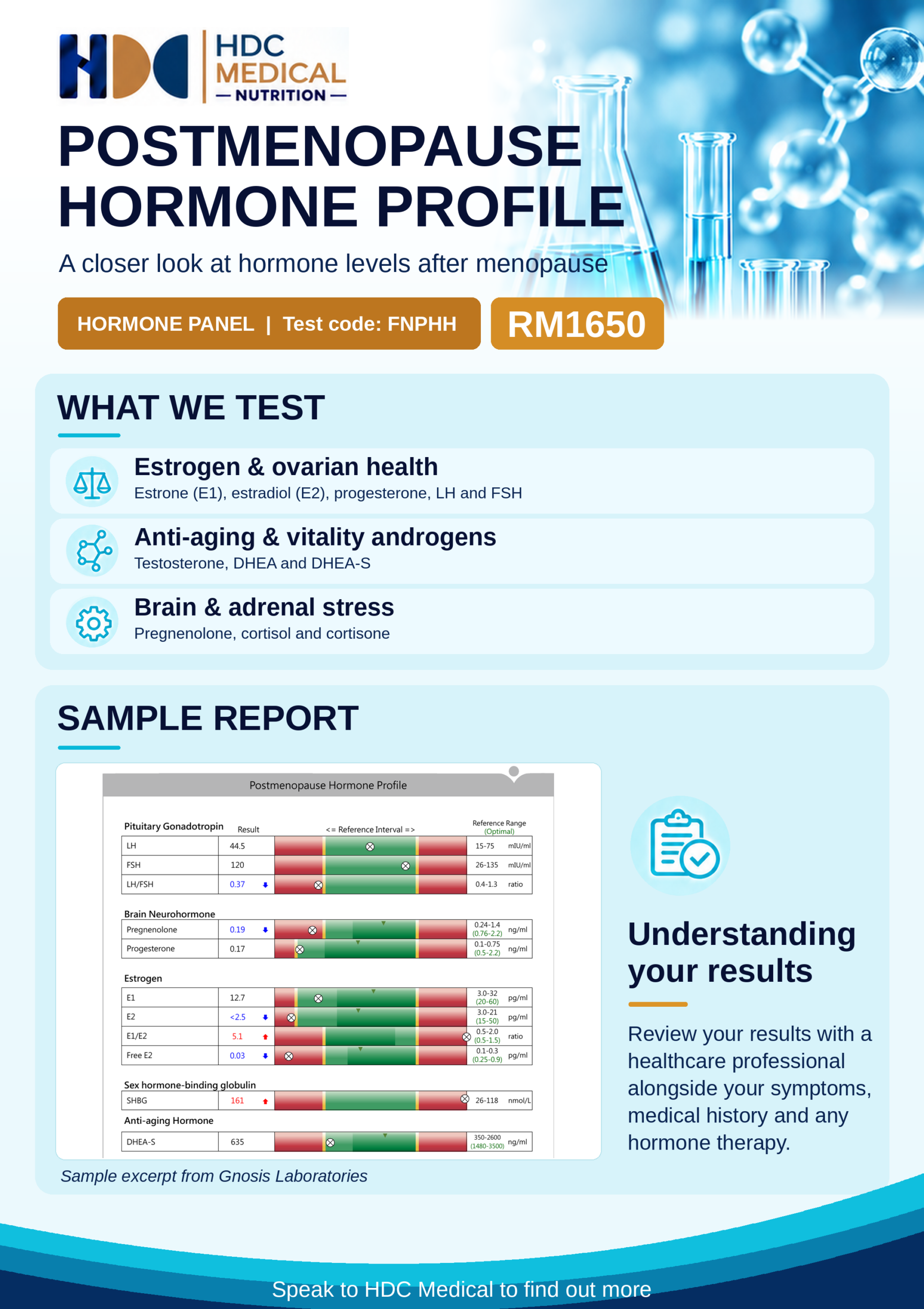
- The profile measures FSH, LH, estrone, estradiol, progesterone, testosterone, DHT, DHEA, DHEA-S, androstenedione, pregnenolone, SHBG and cortisol .
- You do not need a blood test to diagnose menopause if you are over 45 and your periods have stopped; symptoms are enough.
- Low estrogen and high FSH are expected after menopause , not a problem in themselves.
- The results do not decide whether you should take hormone therapy ; that is a decision with your doctor.
- At HDC Medical the profile costs RM1,650 , including an InBody scan and a one-to-one review of your report.
What the postmenopause hormone blood test measures
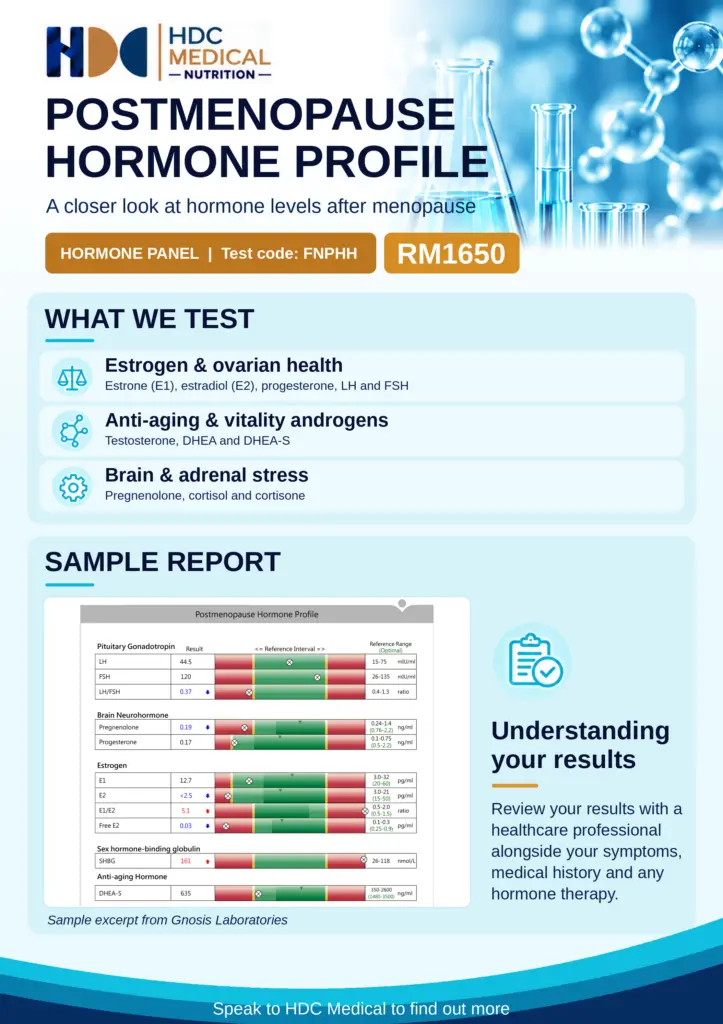
The test uses a blood sample and is analysed by Gnosis Laboratories.
| Group | Markers |
|---|---|
| Brain signals | FSH, LH and their ratio |
| Estrogens and progesterone | Estrone (E1), estradiol (E2), free E2, progesterone |
| Androgens | Testosterone, free and bioavailable testosterone, DHT, DHEA, DHEA-S, androstenedione |
| Neurohormone | Pregnenolone |
| Binding protein | SHBG |
| Stress hormones | Cortisol and cortisone |
What happens to hormone levels after menopause
During perimenopause, the ovaries respond less to signals from the pituitary gland. Ovulation becomes irregular, the menstrual cycle changes, and estrogen levels fluctuate up and down, which is why symptoms can come and go.
After menopause, the ovaries stop releasing eggs. Estradiol falls to low levels, and the pituitary raises follicle-stimulating hormone (FSH) and luteinizing hormone (LH) to try to stimulate the ovaries. Estrone, made mainly in fat tissue, becomes the main form of estrogen. Androgens such as testosterone and DHEA-S decline more gradually with age.
Menopause before 40 is called premature menopause (premature ovarian insufficiency), and before 45 early menopause. Both need a doctor’s assessment, because of the longer-term effects on bones and the heart.
Can a blood test confirm menopause or perimenopause?
Not usually on its own. In perimenopause, FSH levels rise and fall from month to month, so a single normal result does not rule it out. For women over 45, guidelines diagnose perimenopause and menopause from symptoms and changes in the menstrual cycle.
Hormone test results are more useful if you are under 45, if your symptoms are unusual, or if periods stopped after surgery or treatment. Your doctor may repeat FSH and check thyroid function, because thyroid problems can cause similar symptoms.
Who might consider this test
- You are past menopause and want to understand persistent symptoms such as low energy, low libido or poor sleep
- You are discussing hormone therapy with your doctor and want a fuller baseline
- You had menopause before 45 , or after surgery, and want to know where your hormones stand
- You want to see how your androgens and stress hormones compare with the expected ranges for your age
If you are still having periods, or are not sure whether you are in menopause, our menopause blood test guide and women’s health screening are better starting points.
What this test cannot tell you
- It is not needed to diagnose menopause in women over 45. Guidelines diagnose it from symptoms and the change in periods.
- It does not decide hormone therapy. Whether HRT suits you depends on your symptoms, age, time since menopause and personal risks. That is a decision for your doctor.
- If you take hormone therapy, results will reflect it. Tell us exactly what you take and when.
- It does not diagnose bone loss. Bone density is measured with a DEXA scan, which HDC does not offer.
- Any vaginal bleeding after menopause needs a doctor’s review promptly, whatever your blood results show.
Other blood tests worth checking after menopause
- Thyroid function (TSH): thyroid problems are common in midlife and share symptoms with menopause. See our thyroid function test guide .
- Lipid profile: LDL cholesterol often rises after menopause. See our lipid profile guide .
- Blood glucose and HbA1c: diabetes risk rises with age and weight change.
- Vitamin D: important for bone health. See our vitamin D test guide .
Our core blood test packages cover these, and can be combined with the hormone panel.
What you can do to support health after menopause
- Protect your bones: calcium-rich foods (dairy, tofu set with calcium, ikan bilis eaten with bones, dark greens), vitamin D, and weight-bearing exercise
- Protect your heart: heart risk rises after menopause, so check cholesterol, blood sugar and blood pressure regularly
- Keep muscle: strength training two to three times a week and enough protein at each meal
- Watch your waist: fat tends to shift to the abdomen after menopause
- Look after sleep and stress, which affect cortisol and how you feel
Price and booking at HDC Medical
The Postmenopause Hormone Profile costs RM1,650 at HDC Medical in Oval Damansara, Kuala Lumpur. The price includes an InBody body-composition scan and a one-to-one review of your report with our dietitian team, with a practical plan for food, weight and bone health.
If your results need medical follow-up, for example a discussion about hormone therapy, we will suggest you see your doctor or a gynaecologist.
Related reading: menopause and your blood tests , women’s health screening , vitamin D test , blood test packages .
References
- The 2022 Hormone Therapy Position Statement of The North American Menopause Society. Menopause. 2022;29(7):767–794.
- National Institute for Health and Care Excellence. Menopause: identification and management (NG23) .
This article is for general education and does not replace personalised medical advice. Reference ranges vary between laboratories — always interpret your results with a qualified professional. HDC Medical is a dietitian-led health screening centre in Oval Damansara, Kuala Lumpur.
Frequently asked questions
Do I need a blood test to confirm menopause?
Usually not. If you are over 45 and your periods have stopped for 12 months, menopause is diagnosed from your symptoms. Blood tests are more useful if you are younger, or if the picture is unclear.
What is included in the Postmenopause Hormone Profile?
FSH, LH, estrone, estradiol, free estradiol, progesterone, testosterone, free and bioavailable testosterone, DHT, DHEA, DHEA-S, androstenedione, pregnenolone, SHBG, cortisol and cortisone.
What are the symptoms of low estrogen?
Common symptoms include hot flushes, night sweats, vaginal dryness, sleep disturbances, mood changes, joint aches and changes in the menstrual cycle before periods stop.
What lab results show perimenopause?
There is no single result. FSH may be raised, but it fluctuates in perimenopause, so a normal result does not rule it out. Diagnosis in women over 45 is based on symptoms and changes in your periods.
Should my thyroid be checked too?
It is worth checking. Thyroid problems are common in midlife and can cause tiredness, weight change and mood symptoms similar to menopause.
Will this test tell me whether to take HRT?
No. Hormone therapy decisions depend on your symptoms, age, time since menopause and personal health risks. Your doctor will weigh these with you.
How much is a postmenopause hormone test in Malaysia?
At HDC Medical the Postmenopause Hormone Profile costs RM1,650, including an InBody scan and a one-to-one review of your report.
Why is my estrogen low after menopause?
It is expected. After menopause the ovaries make very little estradiol, and most estrogen comes from fat and other tissues as estrone. A low result is normal for this stage of life.
Get clear answers about your hormones after menopause.
Book a dietitian-led screening at HDC Medical in Kuala Lumpur. Your results explained in plain language, with a plan to follow.