
Vitamin D Test: Normal Range, Low Vitamin D and Who Should Test
Malaysia has sunshine all year, yet low vitamin D is common here. Long hours indoors, sun avoidance, covering clothing and sunscreen all cut the amount our skin makes. A vitamin D test is a simple blood test that shows whether your level is low, adequate or high, so you can stop guessing about supplements. This guide explains what the test measures, how to read the result, who should test and how to raise a low level safely.
Part of our blood test results guide: what each marker means and when it is worth testing. New to testing? Start with our guide to getting a blood test in KL.
Key takeaways
- A vitamin D test measures 25-hydroxyvitamin D (25(OH)D) in your blood, the best marker of your vitamin D status.
- Results are reported in ng/mL or nmol/L (1 ng/mL = 2.5 nmol/L). Below 20 ng/mL (50 nmol/L) is generally treated as deficient.
- Low vitamin D is common in Malaysia despite the sunshine , especially if you work indoors, cover up or avoid the sun.
- You do not need to fast for a vitamin D test on its own.
- If your level is low, retest after about three months of changes or supplements, and avoid high doses without advice.
What is a vitamin D test?
Vitamin D helps your body absorb calcium and keep bones and muscles strong, and it plays a part in immune function. Your skin makes vitamin D when sunlight (UVB) reaches it, and a smaller amount comes from food such as oily fish, egg yolks and fortified milk.
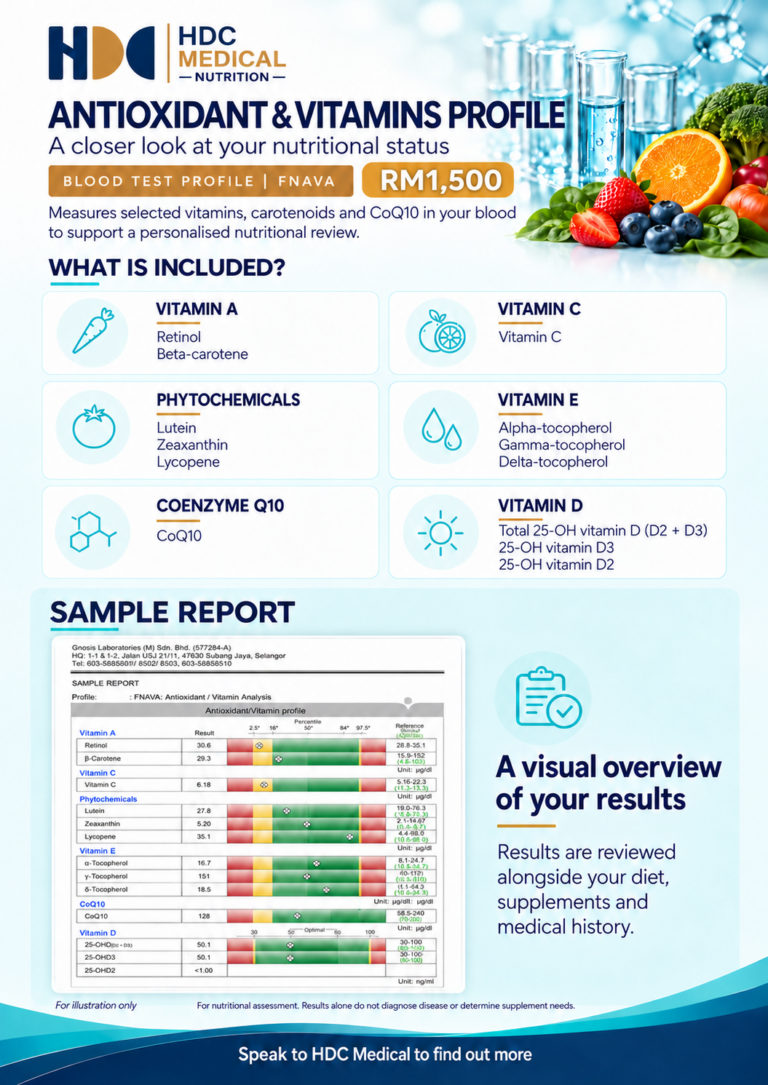
A vitamin D blood test measures 25-hydroxyvitamin D , also written 25(OH)D or 25-OH vitamin D. It is the form that circulates in your blood and reflects both what your skin makes and what you eat or take as supplements, so it is the best single marker of your vitamin D status. Some reports call it vitamin D3 or total vitamin D.
The test needs only a small blood sample from your arm. It does not measure the active hormone (1,25-dihydroxyvitamin D), which is only tested for specific medical conditions.
Vitamin D2 and D3, and why vitamin D matters
There are two main forms. Vitamin D3 (cholecalciferol) is the form your skin makes in sunlight and is found in fatty fish, egg yolks and other animal foods. Vitamin D2 (ergocalciferol) comes from plant sources such as UV-exposed mushrooms and some fortified foods. Both raise your blood level, and the 25-hydroxy vitamin D test measures both together.
Vitamin D helps your gut absorb calcium and phosphate, which you need for healthy bones and teeth. It also supports muscle strength and plays a role in the immune system. Low levels are associated with weaker bones, falls and fractures, and researchers are still studying possible links with other conditions, such as cardiovascular disease.
Vitamin D normal range
Laboratories report vitamin D in either ng/mL or nmol/L. To convert, multiply ng/mL by 2.5. These are the bands most commonly used:
| 25(OH)D level | nmol/L | What it usually means |
|---|---|---|
| Below 20 ng/mL | Below 50 | Deficient |
| 20 to 29 ng/mL | 50 to 74 | Insufficient (some guidelines treat 20 or above as adequate) |
| 30 to 50 ng/mL | 75 to 125 | Sufficient for most people |
| Above 50 ng/mL | Above 125 | Higher than needed; usually from supplements |
| Above 150 ng/mL | Above 375 | Risk of toxicity, almost always from high-dose supplements |
Guidelines differ on the cut-offs: the US National Academy of Medicine treats 20 ng/mL as enough for most people, while the 2011 Endocrine Society guideline used 30 ng/mL. Always read your result against your laboratory’s reference range.
Because the bands differ, one number is less important than the full picture: your symptoms, your bone health, your calcium and kidney results, and what you are already taking.
Why low vitamin D is common in Malaysia
Sunshine alone does not guarantee enough vitamin D. Many people in Malaysia have low levels because of:
- Indoor life: office work, malls and driving mean little sun on bare skin, especially in the middle of the day
- Covering up and sunscreen: both protect the skin but also reduce vitamin D production
- Darker skin: more melanin means the skin needs more sun to make the same amount of vitamin D
- Body weight: vitamin D is stored in fat tissue, so people with obesity often have lower blood levels
- Diet: few local staples are naturally rich in vitamin D
Symptoms of low vitamin D
Most people with low vitamin D have no symptoms at all , which is why a blood test is the only way to know. When symptoms appear, they are often vague: tiredness, aches, muscle weakness or bone pain.
Over time, a significant deficiency can soften bones (osteomalacia in adults, rickets in children) and contribute to osteoporosis and falls in older adults. These are reasons to test if you are at risk, not reasons to panic about one low result.
Who should have a vitamin D test?
Testing everyone is not recommended. In 2024 the Endocrine Society advised against routine vitamin D testing for healthy adults without a specific reason. A test is most useful if you have one or more of these:
- Very little sun exposure, or you usually cover most of your skin
- Osteoporosis, low bone density, a past fracture from a minor fall, or bone pain
- Obesity, or a history of weight-loss surgery
- Conditions that affect absorption, such as coeliac disease or inflammatory bowel disease
- Kidney or liver disease
- Medicines that affect vitamin D, such as some anti-seizure medicines and long-term steroids
- You already take vitamin D supplements and want to check the dose is right
How to prepare for a vitamin D test
- No fasting is needed for vitamin D on its own. If the same blood draw includes fasting glucose or a lipid profile, fast for 8–12 hours; plain water is fine.
- Keep taking your usual supplements unless your doctor says otherwise, and tell us the dose so we can read your result correctly.
- Retest at the same laboratory when you can, as methods differ slightly.
How to raise low vitamin D
If your level is low, the usual options are:
- Sensible sun exposure: short periods with arms and legs uncovered, without burning
- Food: fatty fish such as sardines, salmon and mackerel, egg yolks, and milk, dairy products or other foods fortified with vitamin D
- Supplements: vitamin D3 is commonly used. The right dose depends on your level, weight and health, so ask before taking high doses
- Retest after about three months: blood levels take time to settle after a change
More is not better. Very high doses taken for months can raise calcium to unsafe levels, so test first, then decide.
Vitamin D testing at HDC Medical
At HDC Medical in Oval Damansara, Kuala Lumpur, vitamin D is included in our Nutrient Deficiency Test together with vitamin B12, folate, iron and ferritin, in our Platinum (women’s) and Diamond blood test packages , and in the Anti-Aging Hormone package .
Every package includes an InBody body-composition scan and a one-to-one review of your results with our dietitian team, so a low vitamin D result comes with a practical food, sun and supplement plan, and a date to retest.
Related reading: nutrient deficiency test , ferritin test , blood test in Kuala Lumpur , blood test packages .
References
- Demay MB, et al. Vitamin D for the Prevention of Disease: An Endocrine Society Clinical Practice Guideline. J Clin Endocrinol Metab. 2024.
- Holick MF, et al. Evaluation, treatment, and prevention of vitamin D deficiency: an Endocrine Society clinical practice guideline. J Clin Endocrinol Metab. 2011;96:1911–1930.
- Institute of Medicine (National Academy of Medicine). Dietary Reference Intakes for Calcium and Vitamin D. 2011.
- MedlinePlus. Vitamin D test .
This article is for general education and does not replace personalised medical advice. Reference ranges vary between laboratories — always interpret your results with a qualified professional. HDC Medical is a dietitian-led health screening centre in Oval Damansara, Kuala Lumpur.
Frequently asked questions
What is a normal vitamin D level?
Most laboratories treat 30 to 50 ng/mL (75 to 125 nmol/L) as sufficient, 20 to 29 ng/mL as insufficient and below 20 ng/mL (50 nmol/L) as deficient. Some guidelines consider 20 ng/mL or above adequate for most people.
Do I need to fast for a vitamin D test?
No. Vitamin D can be tested at any time of day without fasting. If your blood draw also includes fasting glucose or a lipid profile, fast for 8–12 hours for those tests.
Why is vitamin D low in Malaysia when it is so sunny?
Many people spend most of the day indoors, avoid the midday sun, cover their skin or use sunscreen, all of which reduce how much vitamin D the skin makes. Darker skin and obesity also lower blood levels.
How much is a vitamin D test in Malaysia?
Prices vary by provider. At HDC Medical, vitamin D is part of our Nutrient Deficiency Test, our Platinum (women’s) and Diamond screening packages and the Anti-Aging Hormone package, each with a one-to-one review of your results.
What are the symptoms of low vitamin D?
Usually none. When symptoms occur they can include tiredness, aches, muscle weakness and bone pain. A blood test is the only reliable way to know your level.
Can you take too much vitamin D?
Yes. Very high doses over a long time can raise calcium to unsafe levels. Toxicity is rare and almost always caused by high-dose supplements, which is why it is worth testing before and after starting them.
Know your vitamin D level, then decide on supplements.
Book a dietitian-led screening at HDC Medical in Kuala Lumpur. Your results explained in plain language, with a plan to follow.