
Omega-3 Index Test: Your Omega 3 Levels and Fatty Acid Profile
Fish oil is one of the most popular supplements in Malaysia, but most people never check whether they need it or whether it is working. A fatty acid analysis measures the fats built into your red blood cells, including the omega-3 index. This guide explains what the test measures, what the numbers mean, its limits and how to raise your omega-3 level through food.
Part of our blood test results guide: what each marker means and when it is worth testing. New to testing? Start with our guide to getting a blood test in KL.
Key takeaways
- The omega-3 index is EPA plus DHA as a percentage of all fatty acids in your red blood cell membranes.
- An index above 8% is commonly used as a target; below 4% is considered low.
- Because red blood cells live about four months, the result reflects your intake over roughly the past three to four months , not just yesterday’s meal.
- The test also reports the omega-6 to omega-3 ratio, the AA to EPA ratio and trans fats .
- At HDC Medical the Fatty Acid Analysis costs RM2,400 , including an InBody scan and a one-to-one review of your report.
What is the omega-3 index?
EPA (eicosapentaenoic acid) and DHA (docosahexaenoic acid) are long-chain omega-3 fatty acids found mainly in oily fish. Your body builds them into the membrane of every cell. The omega-3 index measures how much of the fat in your red blood cell membranes is EPA plus DHA, so it is a biomarker of your long-term omega-3 status.
It was proposed in 2004 as a marker of heart health, because people with a higher index had fewer deaths from heart disease in observational studies. It is also a practical lab test to see whether your dietary intake or supplementation is raising your omega-3 levels.
What the Fatty Acid Analysis measures
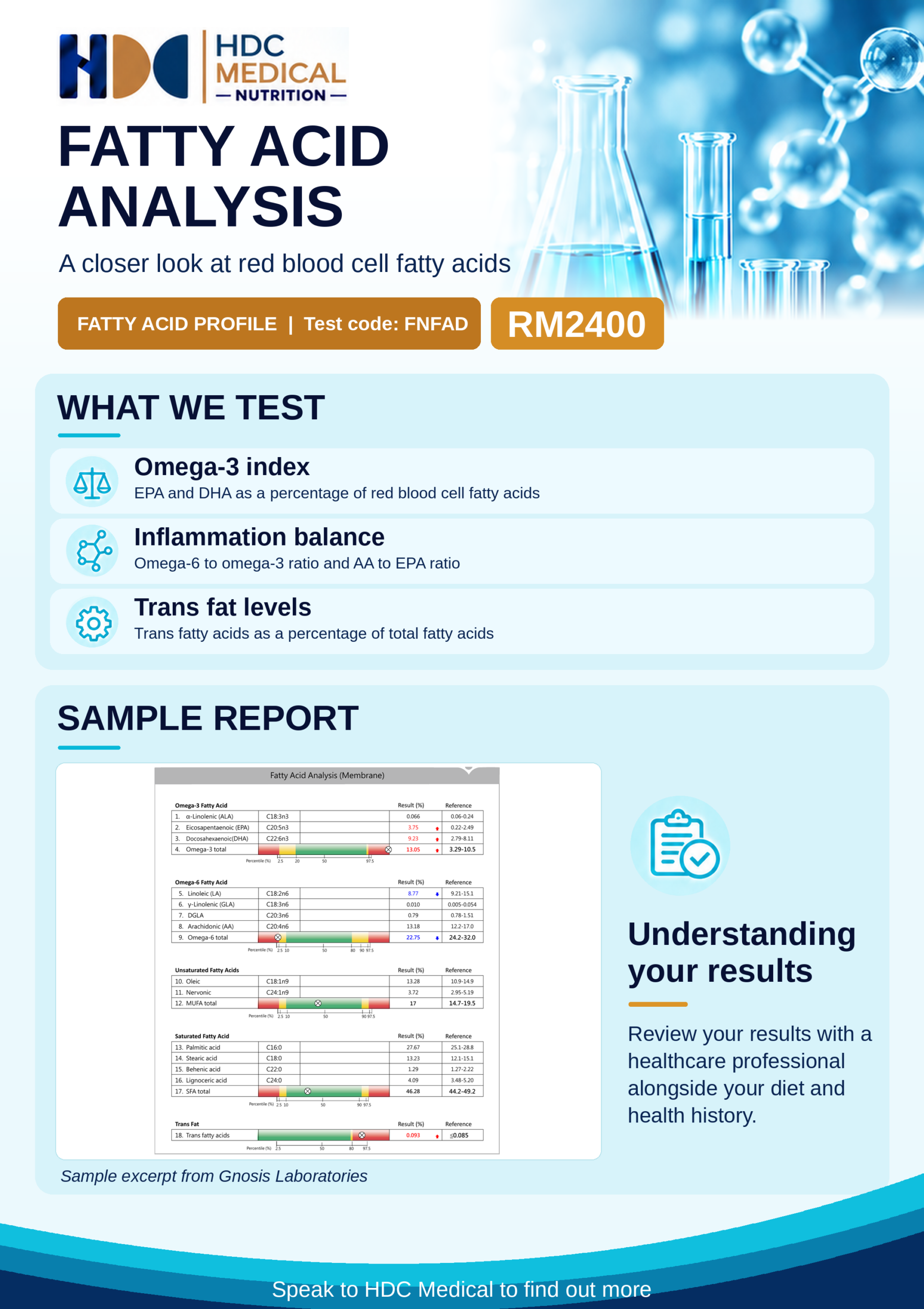
The test is done on a blood sample and analysed by Gnosis Laboratories. It reports:
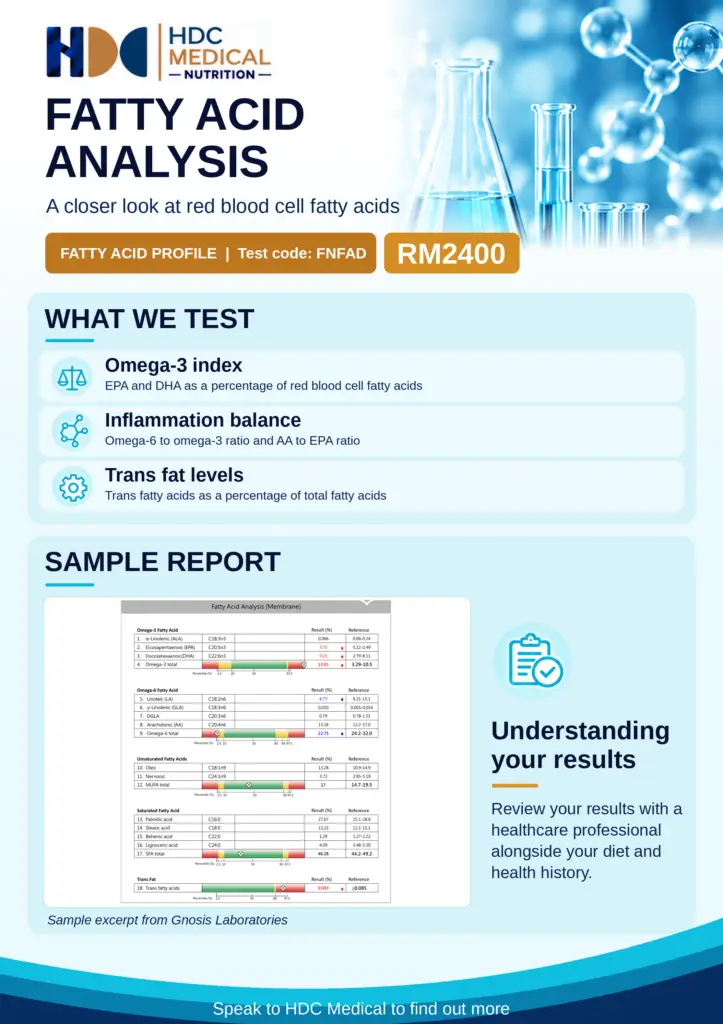
- Omega-3 fats: ALA, EPA, DHA and the omega-3 index
- Omega-6 fats: linoleic acid, GLA, DGLA and arachidonic acid (AA)
- Balance ratios: omega-6 to omega-3, and AA to EPA
- Monounsaturated fats: including oleic acid
- Saturated fats: including palmitic and stearic acid
- Trans fats: as a percentage of total fatty acids
Omega-3 index results: what your fatty acid levels mean
| Result | Commonly used guide |
|---|---|
| Omega-3 index | Below 4%: low · 4–8%: intermediate · above 8%: the usual target |
| Omega-6 to omega-3 ratio | Lower is generally better; typical modern diets run far higher than traditional ones |
| AA to EPA ratio | A higher ratio means more arachidonic acid relative to EPA |
| Trans fats | As low as possible; industrial trans fats have no safe level |
These guides come from research populations, mostly outside Malaysia. Your report shows the laboratory’s own reference ranges, and we interpret them with your diet in mind.
Are you getting enough omega-3?
Most health authorities suggest that healthy adults aim for about 250–500 mg of EPA and DHA a day, which you can get from two portions of oily fish a week. Your omega-3 index shows whether your current intake is getting you there.
Omega-3 fatty acids matter for cardiovascular health, and DHA is a major structural fat in the brain and eyes, which is why omega-3s are studied for brain health. At higher, prescription doses, omega-3s also lower triglycerides. Omega-6 fatty acids are essential fatty acids too; the aim is a better balance, not cutting them out.
Regular eggs provide only small amounts of omega-3, so two eggs a day is not enough on its own for most people. Omega-3-enriched eggs contain more, but still less than a portion of oily fish.
Who might find this test useful
- You take fish oil and want to know whether the dose is doing anything
- You rarely eat fish , or follow a vegetarian or vegan diet
- You are deciding whether to start an omega-3 supplement
- You want to track the effect of a diet change over several months
- You have a family history of heart disease or raised triglycerides and want to check your fatty acid status
If your question is simply about heart risk, a lipid profile with ApoB and Lp(a) is the better first step.
What this test cannot tell you
- A higher omega-3 index is linked with lower heart risk in observational studies , but supplement trials have given mixed results. Raising your index is not proven to prevent heart disease on its own.
- It does not diagnose any disease.
- Reference ranges vary. Many published ranges come from the US and Taiwan, not Malaysia.
- It does not replace your doctor’s advice if you take blood thinners, as high-dose fish oil can add to bleeding risk.
How to raise your omega-3 index through food
- Eat oily fish twice a week: sardines, ikan kembung (Indian mackerel), salmon, tuna or ikan bilis
- Add plant omega-3s: flaxseed, chia seeds and walnuts provide ALA, although the body converts little of it to EPA and DHA
- Cut trans fats: check labels for partially hydrogenated oils, and limit commercial fried and baked snacks
- Consider a supplement only if food is not enough, and ask us about the dose
- Retest after three to four months , once your red blood cells have turned over
Price and booking at HDC Medical
The Fatty Acid Analysis costs RM2,400 at HDC Medical in Oval Damansara, Kuala Lumpur. The price includes an InBody body-composition scan and a one-to-one review of your report with our dietitian team, who will turn the numbers into a practical food plan.
Message us before you book and we will check that the test suits your question, and explain how to prepare.
Related reading: lipid profile test , heart screening package , nutrient deficiency test , blood test packages .
References
- Harris WS, von Schacky C. The Omega-3 Index: a new risk factor for death from coronary heart disease? Prev Med. 2004;39(1):212–220.
- Abdelhamid AS, et al. Omega-3 fatty acids for the primary and secondary prevention of cardiovascular disease. Cochrane Database Syst Rev. 2020;3:CD003177.
- World Health Organization. Trans fat .
This article is for general education and does not replace personalised medical advice. Reference ranges vary between laboratories — always interpret your results with a qualified professional. HDC Medical is a dietitian-led health screening centre in Oval Damansara, Kuala Lumpur.
Frequently asked questions
What is a good omega-3 index?
An omega-3 index above 8% is the target most often used. Below 4% is considered low, and 4–8% intermediate.
Does the omega-3 index show what I ate yesterday?
No. Red blood cells live about four months, so the index reflects your average intake over roughly the past three to four months.
How much EPA and DHA do I need a day?
Most guidelines suggest about 250–500 mg of EPA and DHA a day for healthy adults, roughly two portions of oily fish a week. People with specific heart conditions may be advised higher doses by their doctor.
Do I need to fast for an omega-3 index test?
Fasting is not usually needed for the omega-3 index itself, because it reflects your intake over months. If the same blood draw includes a lipid profile or glucose, fast for those tests. We will confirm when you book.
Can omega-3 help with inflammation?
EPA and DHA are used to make compounds that help resolve inflammation, and high doses lower triglycerides. Their effect on everyday inflammatory symptoms is modest, so they work best as part of an overall healthy diet.
Do I need fish oil?
Not always. If you eat oily fish twice a week, you may already have a good index. The test shows whether your current intake is enough before you spend money on supplements.
How much is an omega-3 index test in Malaysia?
At HDC Medical the Fatty Acid Analysis, which includes the omega-3 index, costs RM2,400 with an InBody scan and a one-to-one review of your report.
Is ikan kembung a good source of omega-3?
Yes. Indian mackerel (ikan kembung) is a local oily fish that provides EPA and DHA, and it is usually cheaper than imported salmon.
Find out whether your omega-3 intake is enough before you buy supplements.
Book a dietitian-led screening at HDC Medical in Kuala Lumpur. Your results explained in plain language, with a plan to follow.